Car Care · Ownership
Your car doesn't age all at once. It ages in the small scratches you learn to ignore.
A fresh scuff in a parking lot rarely seems worth a body-shop bill — so most owners do nothing. Here's the at-home fix people try first on surface marks, and the honest line where it stops working.
Disclosure: This article contains affiliate links. If you buy through them we may earn a commission, at no extra cost to you. Our take is editorial.
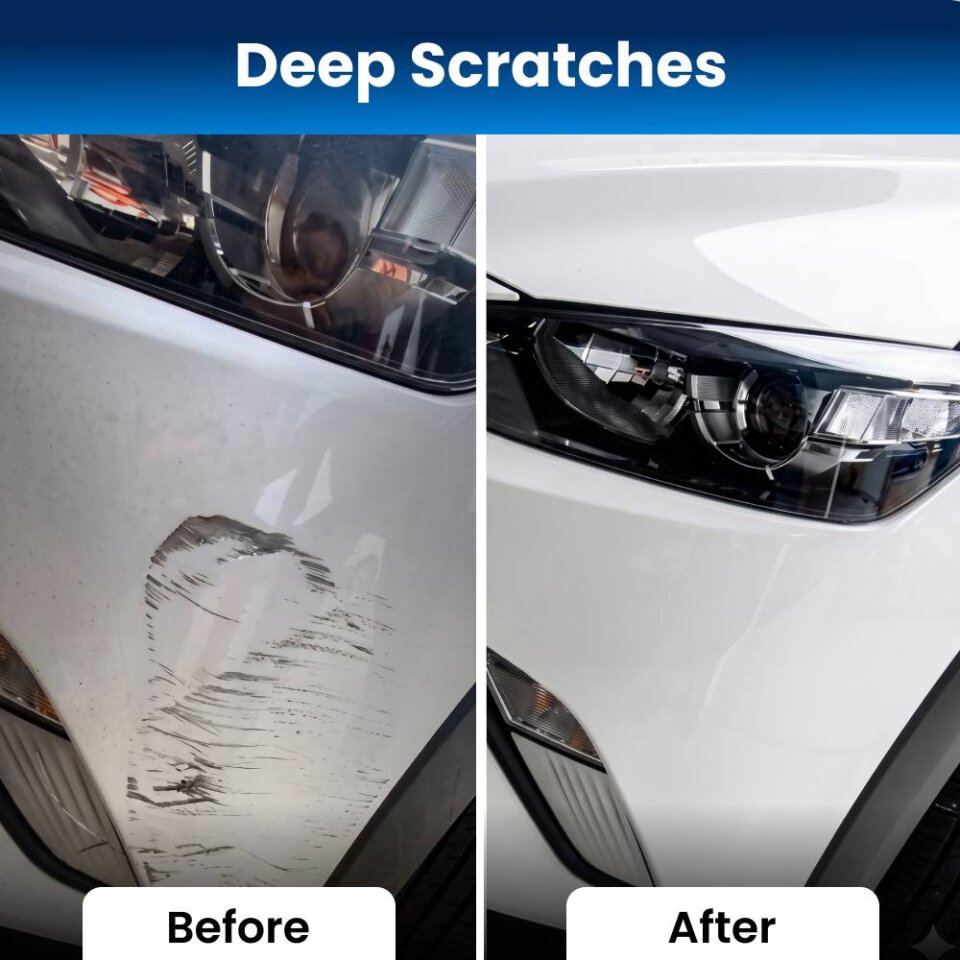
You come back to the lot with both hands full of groceries, and there it is: a fresh line across the driver's door that wasn't there an hour ago. You run a thumb over it. You tell yourself it's nothing. Then you spend the entire drive home glancing at it in the corner of your eye, doing quiet math about what it's going to cost to make it disappear.
That math is usually where the story ends. You call a shop, the quote comes back somewhere between a long dinner and a car payment, and the scratch is small enough that paying that feels absurd — so you don't. The mark stays. A month later there's another one near the handle. Then a scuff on the bumper. None of them is worth a shop visit on its own, so none of them gets fixed.
The real problem
A car doesn't look old because of one big thing. It looks old because of a dozen small marks the owner decided not to deal with. The enemy isn't the scratch. It's the quiet pile-up of "I'll get to it later."
Body shops aren't overcharging, to be clear — cosmetic paint work is genuinely labor-heavy. But the price is built for serious damage, and most of what bothers owners isn't serious. It's surface stuff: key marks, hedge and branch scuffs, shopping-cart taps, swirl marks, light oxidation on an older panel. Cosmetic, shallow, annoying.
What owners report paying for cosmetic work
So a category of owners has started doing the obvious thing: before booking a shop for a mark that may not need one, they try to handle the surface scratch themselves. The tool most of them mention is a treated cloth sold under the name NanoPolix.
What it actually is
It isn't a magic eraser, and it shouldn't be sold as one. It's a cloth carrying a fine polishing compound — a portable polishing layer that you rub into the affected area in small circular motions. On surface scratches, that compound fills and smooths the shallow groove and brings the shine back to the spot, so the mark stops catching the light and reading as damage. No drying time, no spray, no kit.
"I'd been putting off a scratch by the trunk handle for months because I couldn't justify $200 for something that small. Did it myself in one sitting — now I'm just annoyed I waited." — the recurring theme in owner reviews
Where it works — and where it doesn't
This is the part most product pages skip, and it's the part that actually matters. Being honest about the limit is what tells you whether it's worth your money.
Good for
- Light key marks and fingernail scratches
- Branch, hedge, and shopping-cart scuffs
- Swirl marks and light surface oxidation
- Marks you can barely catch a fingernail in
Not for
- Deep gouges that reached the primer or metal
- Dents, cracks, or structural damage
- Anything your fingernail clearly drops into
- A guaranteed fix on every scratch — it won't be
If the damage is deep enough to feel like a real step under your nail, that's a body-shop job and no cloth will change that. The point of trying this first is simpler: a lot of what makes a car look uncared-for is shallow, and shallow is exactly what this is built for.
How owners use it
Clean the spot
Wipe the scratched area dry so there's no grit or debris to drag across the paint.
Work it in
Rub firmly over the mark in small circular motions and watch it lift as you go.
Buff clean
Wipe away any residue. The treated area should read smooth and reflective again.
Why people try it before the shop
One owner used it on lease-return scuffs and passed inspection with no charge. Another had been burned twice by liquid scratch kits and expected the worst — and didn't get it. The common thread isn't "it fixed everything." It's "it handled the small stuff so I didn't have to pay for the small stuff."
The honest bottom line
NanoPolix isn't going to rescue a car from real collision damage, and anyone telling you it removes every scratch is overselling it. What it does is give you a cheap first move on the surface marks that quietly age a car — the ones you'd otherwise either ignore for years or overpay a shop to fix. If it handles the mark, you've saved a body-shop trip. If it doesn't, you're out a few dollars and you book the shop anyway. For shallow, cosmetic scratches, that's a reasonable bet to make before the expensive one. You can check the current offer here.